
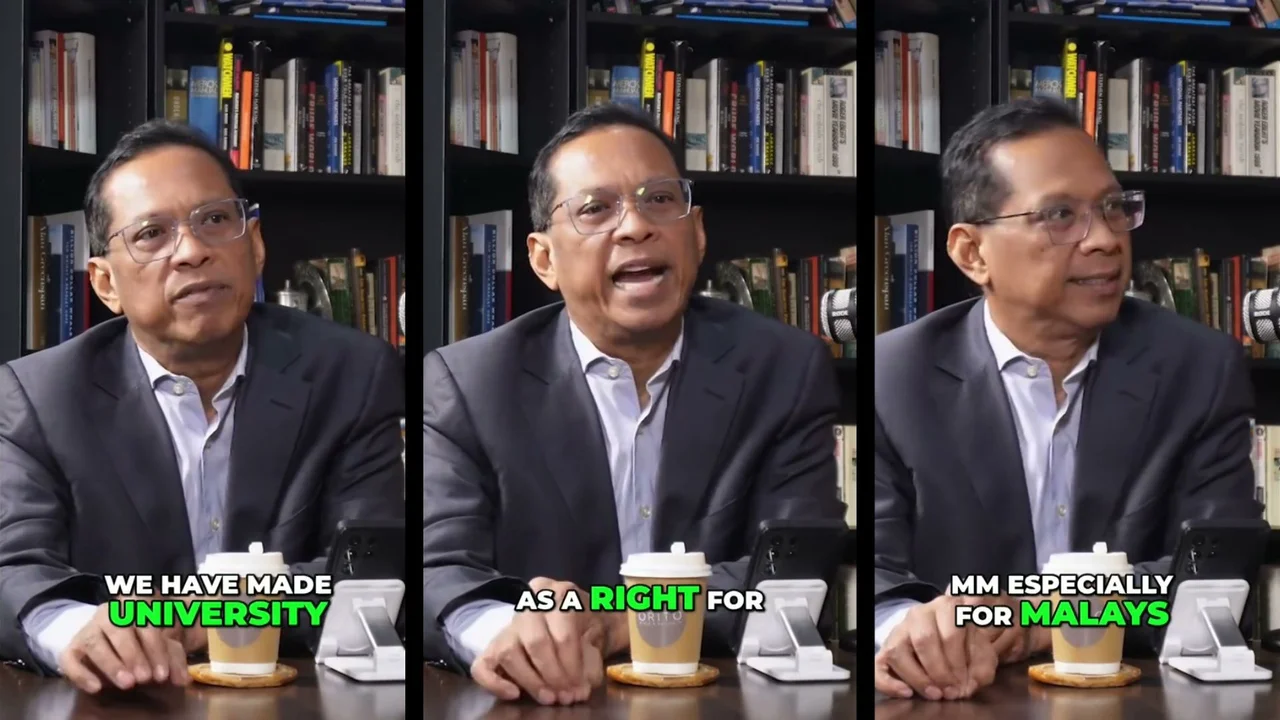
‘We have made the university, as a right, to be in, especially for Malays’ — Businessman Shamsul Saad says it’s ‘one of the worst things happened in Malaysian education system’
‘We have made the university, as a right, to be in, especially for Malays’ — Businessman Shamsul Saad says it’s ‘one of the worst things happened in Malaysian education system’

Summary
Shamsul Saad, a Malaysian businessman, expressed that Malaysian universities shouldn’t be treated as a right to automatic admission, especially for Malays, in a podcast clip uploaded to TikTok on Sept 7.
Malaysia’s public university admissions now use academic and co-curricular scores, while Bumiputera, a term referring mainly to Malays and the indigenous peoples of Sabah and Sarawak, preferences remain through several education pathways.
Malaysia’s current affirmative-action policies in education grew out of policies introduced after 1969, rather than from the actions of any one prime minister.
MALAYSIA: Shamsul Saad, a Malaysian businessman and host of The Gutshot Podcast where he goes by the nickname Sam, has reignited a long-running Malaysian debate: should university admission be treated as a right, particularly for Malays, or determined primarily by academic merit?
Speaking with Professor Tajuddin Rasdi, Shamsul said: “That is one of the worst things that has happened in the Malaysian education system.” The podcast host then argued that Malaysia had made university admission a right “for everybody to be in, especially for Malays”.
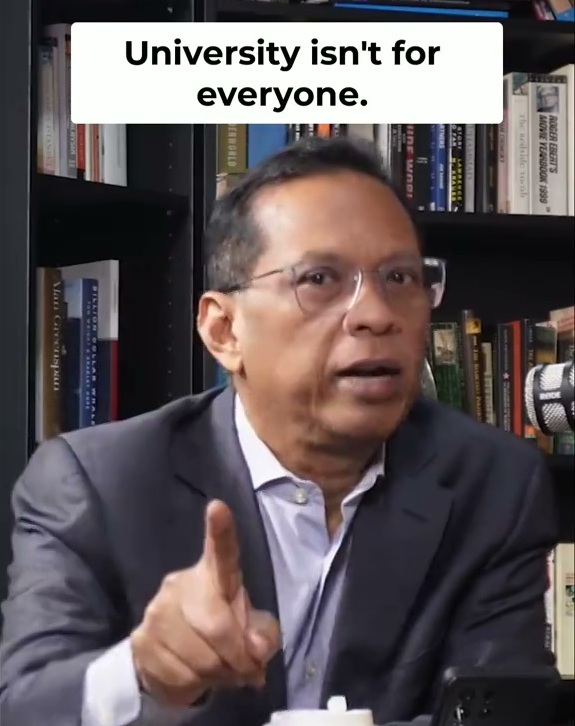
Shamsul’s remarks appeared in a TikTok video by The Gutshot Podcast on Sept 7. His conclusion was that “University is not for everybody. In fact, university is not for most people.”
Some online reactions to Shamsul’s remarks focused on maintaining academic standards.
One commenter said university admissions should prioritise quality and merit regardless of race or social status. Another argued that opening university to everyone without sufficient standards could reduce the value of a degree.
Others pushed back against Shamsul’s wording, asking why Malays were singled out and whether the comment implied that Malays were incapable of succeeding without special treatment.
Those reactions capture the central tension of Shamsul’s remark, while the phrase “a right to university” for the Malays calls for a closer look before its meaning can be properly understood.
Malaysia doesn’t give Malays an automatic university admission
Malaysia’s current public university admission system is formally based on merit. The Ministry of Education says that Unit Pusat Universiti (UPU), or University Central Unit, admissions use 90% academic marks and 10% co-curricular marks.
Some university foundation programmes, however, remain restricted to Malays, Anak Negeri Sabah, Anak Negeri Sarawak and Orang Asli. Universiti Teknologi MARA (UiTM), for example, is listed among programmes open only to these groups.
The Matriculation Programme also retains a 90:10 Bumiputera-to-non-Bumiputera quota. The government has kept that arrangement while expanding the number of places.
So the reality is neither “everyone gets university access” nor simply “Malays get university access regardless of their academic results”. There are different routes into Malaysian higher education, each with its own set of rules.
The race-based admission policy was created to address deep economic and education gaps
Malaysia introduced a comprehensive affirmative-action system through the New Economic Policy in the 1970s, following the May 13, 1969 racial riots. The policy was partly intended to reduce economic and social disparities between ethnic groups.
The Federal Constitution also provides a constitutional basis for reservations involving education. Article 153 requires the Yang di-Pertuan Agong (Malaysia’s King and head of state) to safeguard the special position of Malays and natives of Sabah and Sarawak, while also protecting the legitimate interests of other communities.
Article 153(8A), inserted in 1971, specifically allows directions concerning the reservation of places in universities and other post-secondary institutions when qualified applicants exceed available places.
The old university admission system used a reported 55:45 Bumiputera-to-non-Bumiputera ratio. The government moved towards meritocracy in 2002, replacing the old 55:45 quota for public university admissions with a merit-based system.
And while the replacement of the old education system was under then-Prime Minister Mahathir Mohamad’s administration, it would be inaccurate to say Mahathir created the entire education system.
In 2019, Mahathir said the matriculation route had been created because many Malay students were not taking the Higher School Certificate, now known as Sijil Tinggi Persekolahan Malaysia (STPM), and therefore struggled to enter university.
The Matriculation Programme itself was placed under the Education Ministry in 1998, when Najib Razak was education minister.
In other words, the system is the product of several government policies over decades rather than from the actions of any one prime minister.
Affirmative action was introduced after years of racial and economic inequality
There is a reason supporters continue to defend these policies. Government explanations for the policies have focused on historical differences in educational access, income and opportunities, particularly among poorer and rural Bumiputera communities.
In 2019, then Education Minister Maszlee Malik said the government retained the 90:10 matriculation quota while increasing the total number of places. He pointed to B40 students, including non-Bumiputera students, who also needed access to education.
Critics online, meanwhile, argue that race-based routes can disadvantage students from other communities who achieve strong results but face different pathways into higher education.
Newsletter
Get updates straight to your inbox
The disagreement is therefore less about whether Malaysians should study at university. It’s more about how limited places should be allocated when there are more qualified applicants than available seats.
Merit, access and fairness are still competing concerns
The debate therefore centres on how Malaysia should balance academic merit with policies to address unequal starting points. At the same time, governments may use targeted support to address unequal starting points.
The difficult part is deciding where assistance should end and merit-based selection should begin, which is ultimately a policy question for the government, and not something that can be easily settled by just saying either “everyone deserves university” or “university isn’t for most people”.
Shamsul’s remarks have therefore opened a deeper question over where Malaysia should draw the line between affirmative action and merit-based selection.
Nevertheless, the data shows that the Malaysian government’s affirmative action greatly expanded Bumiputera access to higher education and helped increase their presence in professional and managerial careers.
At the same time, gains in education yield mixed results. According to the ISEAS – Yusof Ishak Institute, a Singapore-based research institute focused on Southeast Asia, the affirmative-action policies have fallen short in developing capabilities and competitiveness, with persistent concerns over graduate quality and underemployment.
Taken together, these data and reports now add another dimension to the debate over how Malaysia balances affirmative action, university admission and academic merit, while the government continues to navigate how best to ensure opportunities remain fair and open to all students from different backgrounds.
Some original quotes have been minimally edited for brevity and clarity.